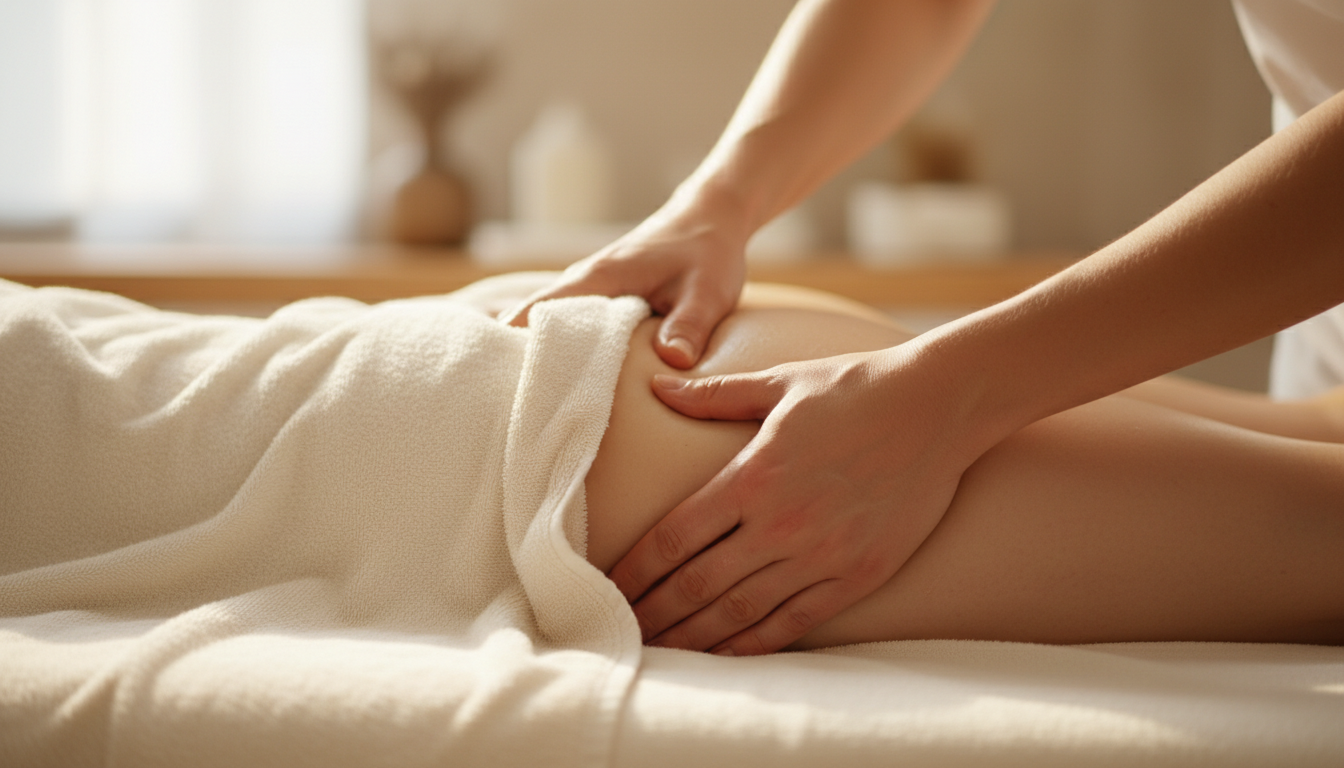
Some people believe that a painful, knuckle-deep buttock massage breaks cellulite apart by force. Others tried a few gentle sessions, saw nothing, and concluded that massage is a waste of time and money. Both reactions are understandable — and both miss the point. Anti-cellulite buttock massage works, but only when the method matches the tissue condition and is applied consistently.
The real problem with cellulite on the buttocks
Cellulite on the buttocks is a structural and aesthetic problem, not a simple issue of excess weight. Many lean, active people have visible dimples because the appearance depends on how fat is organized beneath the skin, how the connective tissue anchors it, and how well blood and fluid move through the area.
This is why a scattered approach rarely helps. A random self-massage here, a professional session there, a device used for three days — none of these address the underlying structure. Worse, aggressive massage that leaves bruises often makes the skin look more uneven, not less. A useful protocol has to work with the tissue, not against it.
Why skin dimples and why massage alone often fails
To understand what massage can and cannot do, it helps to look at the anatomy. Beneath the skin, fat lobules are separated by bands of connective tissue called septae. In areas with cellulite, these bands tighten while the fat lobules push upward. The result is the familiar dimpled surface.
Three additional factors make it more visible:
- Reduced microcirculation in the affected zone, which limits oxygen and nutrient delivery to the skin and deeper tissue layers.
- Fluid retention, which increases pressure in the tissue and makes it feel heavy or swollen.
- Fibrosis, or stiffening of the connective tissue, which makes the surface feel more rigid and the dimples more pronounced.
Massage alone often fails because most people use the wrong approach. Too-light work does not influence circulation or tissue stiffness. Too-aggressive work damages capillaries and causes bruising, which triggers inflammation that can actually make the area look worse. And irregular sessions — even with the correct technique — do not produce visible change. The tissue needs repeated, consistent stimulation to respond.
What massage can realistically do is improve microcirculation, reduce fluid load, and gradually soften fibrotic areas. What it cannot do is destroy fat or cut connective bands. Claims that a single technique, manual or mechanical, can break cellulite apart by force are not supported by how the tissue actually behaves.
Manual massage techniques and their realistic effects
Manual techniques for cellulite fall into two broad categories, and it helps to know the difference before booking a session or starting self-work.
Lymphatic drainage
Light, rhythmic, directed strokes are designed to move excess fluid from the tissue toward the lymphatic system. This works well for reducing swelling and making the skin look smoother in the short term. But lymphatic drainage does not change the structure of connective tissue, so its effect is temporary — usually a few days.
Deeper tissue work
Techniques such as skin rolling, deep stroking, and myofascial release target the stiffened connective tissue. Done correctly, they help restore sliding between tissue layers and soften fibrotic bands. This is where serious manual cellulite massage shows its value. It is also where most people make mistakes: pressing too hard, working too briefly, or using a technique that does not match the area.
Professional manual work has a clear advantage: a skilled practitioner can feel the tissue and adapt pressure and direction in real time. The downside is that the effect depends heavily on the practitioner’s experience, and several sessions are needed before visible changes appear.
Self-massage with hands or small tools is a reasonable maintenance option. It cannot match a professional’s ability to assess the tissue, but it keeps blood moving and helps preserve results between sessions. The key is to use medium pressure — enough to move the skin and underlying layers, not enough to bruise.
Manual cellulite massage works when it targets the right layer, uses adequate pressure, and is repeated often enough for the tissue to respond. Bruising is not a sign of effectiveness; it is a sign of force used incorrectly.
Mechanical and vacuum-roller approaches
Mechanical anti-cellulite massage removes some of the variability of manual work. Vacuum-roller devices, used in clinics or with home-use machines, pull the skin into a suction chamber while rollers knead it. This provides deep, consistent stimulation that is difficult to maintain manually over a longer session.
The main advantages are consistency and depth. A machine does not get tired, can maintain a uniform pressure, and covers the same area repeatedly. For many people, these devices produce faster visible smoothing than manual self-massage alone, mainly because the deep kneading improves circulation and reduces fluid retention more effectively.
There are also percussion and vibration massagers. These feel intense but act more superficially. They can be useful for warming up the tissue or general relaxation, but they do not address the connective tissue stiffness or fluid stagnation that drives the appearance of cellulite.
The caution with mechanical methods is overstimulation. High suction or aggressive roller pressure can break capillaries, cause bruising, and inflame the tissue. Inflamed tissue holds more fluid and appears more uneven — the exact opposite of the intended result. Machine use should be introduced gradually and adjusted so that it feels firm but not painful.
What the practical comparison shows
When comparing manual and mechanical buttock massage for cellulite, the decision framework comes down to five practical factors: effort, cost, consistency, risk, and how long the results last.
| Factor | Manual professional massage | Self-massage | Mechanical device (vacuum-roller) |
|---|---|---|---|
| Effort | Appointments required; you stay passive | Requires daily discipline and correct technique | Setup and use at home; consistent effort needed |
| Cost | Highest per session | Low; only tools and time | Moderate one-time investment |
| Consistency | Limited by schedule and budget | Easy to skip or do incorrectly | High once the device is available |
| Risk | Low if the practitioner is skilled | Bruising from excessive pressure | Bruising if suction or pressure is too high |
| Duration of results | Several days to a few weeks | Short unless performed regularly | Several days to a few weeks |
Neither approach wins outright. Professional manual massage offers precision but is limited by cost and schedule. Mechanical devices offer consistency but require careful adjustment. For most people, the most realistic path is a combination: targeted manual work to assess and address problem areas, plus controlled mechanical stimulation for ongoing maintenance.
A step-by-step protocol for visible improvement
Visible improvement requires a repeatable weekly plan. The protocol below combines tissue preparation, manual drainage, deeper massage work, and controlled mechanical stimulation. It is designed to be practical, not time-consuming.
Step 1: Prepare the tissue (5 minutes). Take a warm shower or apply a warm towel to the buttocks for a few minutes. Warmth increases blood flow and makes the tissue more pliable. Then apply a light layer of massage oil or lotion to reduce friction.
Step 2: Manual lymphatic drainage (10 minutes). Use light, slow, sweeping strokes directed toward the lymph nodes in the groin. This clears excess fluid and prepares the tissue for deeper work. Keep the pressure gentle; if the skin turns red or hurts, you are pressing too hard.
Step 3: Deeper massage work (15 minutes). Use skin rolling, knuckle gliding, or a vacuum-roller device at medium intensity. Work over the entire buttock area, spending extra time on the most dimpled zones. If you feel pain or see bruising the next day, reduce the intensity for the next session.
Step 4: Cool down and hydrate. End with light stroking and drink a glass of water. Hydration supports the circulatory response that the massage has triggered.
Repeat this cycle three to four times per week for at least six weeks before judging the results. The tissue needs multiple weeks of consistent input to change its appearance. If no difference appears after that time, reassess your technique or consider professional guidance.
Prevention and maintenance after the results
Once the appearance improves, the challenge is keeping it that way. The structural forces behind cellulite do not disappear; they return when treatment stops. Maintenance means continuing the work at a reduced frequency, not stopping completely.
- Keep one or two sessions per week of the protocol above. This is usually enough to preserve visible gains.
- Stay hydrated. Fluid retention amplifies the dimpled look, so regular water intake keeps the tissue less puffy.
- Move throughout the day. Prolonged sitting compresses the buttocks and reduces circulation. Standing breaks, walking, and glute activation exercises support the microcirculation that massage improves.
- Use daily skin care. Moisturizing ingredients keep the skin elastic, which makes the dimples less pronounced — especially on days without a full massage session.
There is no reason to chase painful treatments or expensive shortcuts. A cellulite massage protocol that matches the tissue condition, uses the right technique and pressure, and follows a realistic schedule is what actually makes the difference. Choose the method you can sustain, apply it consistently, and let the tissue tell you what works.
