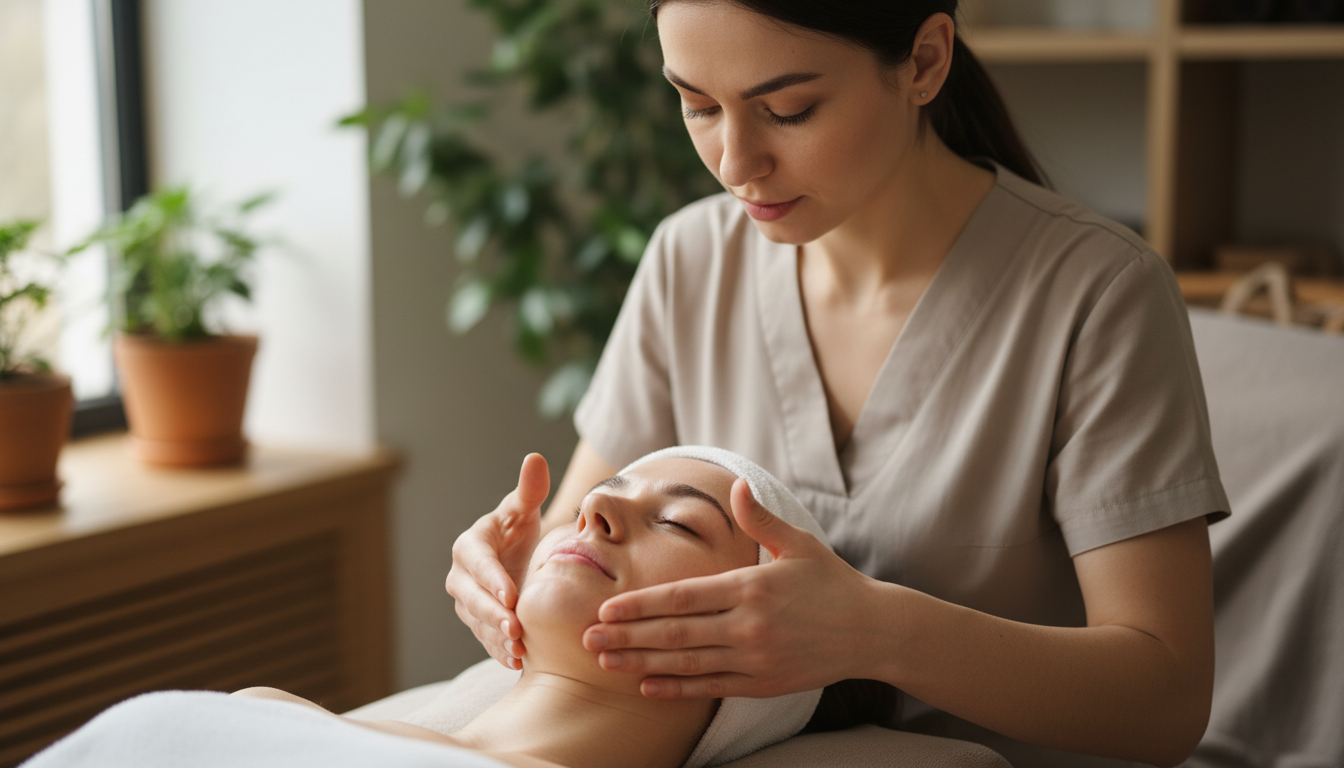
Is the current obsession with sculpted cheekbones, defined jawlines, and "glass skin" actually new? Scroll through any beauty feed and you'll find another video of someone pressing, stroking, and rolling their face with tools that range from ancient-looking to aggressively modern. It's easy to assume this is a trend born of the algorithm era. But the real facial massage history is neither short nor conveniently new. Manual facial massage has been part of beauty and healing culture for centuries, long before anyone ever called it "face yoga" or "sculpting."
This is not a guide to the latest viral technique. It's a look at where this practice comes from — how something as simple as using your own hands became a professional skill, then lost its place in the glow of electric machines, and is now quietly making its way back into everyday skincare.
Where the need for facial massage first appeared
Long before skincare routines had steps and layers, human hands were already moving across faces. The impulse to touch, press, and rub the face is one of the oldest instincts we have. By the time it became a formal practice, it was tied to healing systems, not vanity.
Ayurveda, one of the world's oldest holistic healing traditions, has long included face and head work in self-care rituals. In traditional Chinese medicine, pressure applied to the face was understood to influence energy flow through the body's meridian pathways, releasing tension and supporting circulation. In Japan, the intricate manual technique often associated with classic beauty culture uses rhythmic, precise hand movements along the face and neck. Some practitioners link it to ancient court practices, though the exact historical timeline is not always verifiable.
The common thread across these traditions is a belief in a face-body connection. The complexion was never treated as a separate surface. Tension, stress, and poor circulation were understood to show up on the skin, and massage was a direct way to address the state of the body through the face. That is not a trivial idea — it is the same reasoning that underpins much of today's renewed interest.
When hand massage became a professional skill
The shift from home practice to professional service began in earnest in the late nineteenth and early twentieth centuries, as modern beauty culture took shape. No longer just a personal habit, facial massage started appearing in beauty manuals as a defined, teachable skill.
In the fashionable salons of Paris, London, and New York, trained facialists — the predecessors of today's aestheticians — built their reputations on manual work alone. A typical salon facial revolved around a structured massage sequence. Creams were applied by hand, followed by movements intended to stimulate the skin, ease facial muscles, and aid blood flow to the cheeks. The client would leave with something today's marketers would simply call a glow.
It was during this period that facial massage techniques became codified. Movements borrowed from body massage — effleurage, petrissage, tapotement — were adapted to the delicate structures of the face. They had names, sequences, and clear principles. Many of the techniques used in modern hand facial massage trace directly back to those early beauty manuals.
This professionalization mattered. It gave manual facial massage credibility, a recognized skill set, and a whole category of specialists who could answer one practical question: "What exactly should I do with my hands?" The answer was no longer vague. It was a craft.
The machine age pushed manual work to the margins
But a craft performed by hand is also slow. And in the twentieth century, slow became suspect.
The beauty industry embraced electricity with enthusiasm. High-frequency wands, galvanic currents, vacuum suction, and later microdermabrasion machines promised faster, more "scientific" results. A salon without equipment began to look unprofessionally bare. The aesthetic shifted from skilled fingers to humming devices, and the role of the facialist changed accordingly.
Around the same time, clinical dermatology was gaining ground. Retinoids, chemical peels, and eventually injectables offered visible changes with clear mechanisms of action. Against this backdrop, pressing a face with bare hands looked almost primitive. Manual work was quietly rebranded as a luxury add-on, a pleasant extra before the "real" treatment began. In some circles, relying on massage at all was seen as old-fashioned thinking.
This push to the margins had a lasting effect. Many consumers came to believe that skincare without equipment was incomplete. And it's telling that even today, the phrase "just massage" carries a hint of dismissal in certain conversations.
Why hands are making a comeback in modern skincare
And yet, the same industry that pushed hands aside now finds itself returning to them. The comeback isn't one celebrity endorsement. It's cultural.
The skin barrier conversation changed everything. A decade of aggressive exfoliating and active-ingredient layering left many people with irritated, dehydrated skin. The common advice from dermatologists became: simplify, support the barrier, stop attacking. Massage fits naturally into this gentler philosophy — no harsh ingredients, no invasive process, just circulation, relaxation, and time.
Ritual has become a form of self-care. When life moves on screens, there is real meaning in an unplugged five minutes: a few drops of oil, fingertips, breath. Hand facial massage is accessible in a way that devices and dermatology are not. You already own your hands. The barrier to entry is close to zero, and that makes the practice feel like an act of agency.
Touch itself has healing power. The face is rich in nerve endings. Gentle pressure from fingertips can calm the nervous system, slow a racing mind, and release the chronic clenching that many of us carry in the jaw and brow. You don't have to buy into esoteric claims to notice that a short facial massage just makes you feel different.
Manual facial massage isn't a shortcut or a miracle. It's a discipline of attention — a way of reconnecting to the physical reality of your face in a culture that spends too much time looking at it through screens.
What manual facial massage can and cannot do
Let's be clear about limits. No amount of pressing and stroking will give you a facelift. It will not reshape your bone structure, erase deep static wrinkles, or change how your skin fundamentally ages. If you're considering it as an alternative to medical treatment, that's the wrong lens.
But the facial massage benefits that survive honest scrutiny are not trivial:
- Reduced puffiness. Gentle, directional movements support lymphatic drainage, especially around the eyes and jaw. Many people notice a visible difference in the morning.
- Relaxed facial muscles. We clench without noticing. Massage releases tension in the masseter, the forehead, and the space between the brows — and a relaxed face reads as softer and calmer.
- Better product absorption. Massage spreads skincare evenly and helps it settle into the skin. It's the opposite of a "pat and pray" routine.
- A circulatory boost. Increased blood flow brings oxygen and nutrients to the skin surface, which contributes to a more even, healthy-looking tone.
- Genuine relaxation. This is not a side benefit. The calming effect is a legitimate outcome, and it's part of why the practice feels good enough to repeat.
What it cannot do is match the intervention-level results of cosmetic medicine. Massage doesn't lift deep tissue permanently. It doesn't fill volume. It doesn't stop collagen breakdown. If those results are what you need, no facial massage technique — however well executed — will substitute for medical care.
The honest framing is this: manual facial massage is a maintenance practice, not a transformation practice. It supports the skin and the body's own functions. It spoils no one, costs little, and is grounded in a simple pleasure — the feeling of your own hands on your own face.
Where the practice is heading next
The future of facial massage is likely to be a blend rather than a return to the past. We're already seeing the emergence of hybrid routines: people who use microcurrent devices, LED masks, or gua sha stones, but also return to their hands for the parts that require sensitivity and intuition. Technique and tool are starting to work in tandem.
Research on touch — its effects on stress, circulation, and nervous system regulation — continues to grow, even if studies on facial massage specifically remain far behind the marketing rhetoric. That's not a reason to dismiss the practice. It's a reason to stay skeptical of grand claims and appreciative of small ones.
Where that leaves you is with an unglamorous truth: the history of manual facial massage is the history of people paying attention to their faces. Not with expensive instruments, not with invasive procedures, but with the most basic tool available — the human hand. Whether it's called manual facial massage, hand massage, or simply "taking a few minutes with your fingertips," the practice is older than your skincare feed and probably more honest.
So the next time you scroll past yet another technique promising a sharper chin or a lifted brow, you'll know the backstory. The fascination with sculpted skin is not new — the ancient circuits of the face have been explored, soothed, and shaped by human fingers for centuries. What's new is just the marketing. The practice itself has been waiting for you all along.
